TikTok Shop processed over $64 billion worth of merchandise in 2025, and scammers have taken notice. The platform's breakneck pace is one of its main selling points, allowing merchants to drive sales faster than traditional marketing. A compelling product video, a ticking countdown timer, and a one-tap checkout are all designed to get you to buy before you've had a chance to think twice.
But this is exactly how you might stumble into one of many TikTok Shop scams.
Scam Detectors Most Trusted Websites in Online Security
- Guard.io (100): Protect your digital world on any device – Guardio stops scams and phishing in their tracks.
- Incogni.com (100): Delete your personal data from the internet and protect against scams and identity theft.
- ExpressVPN (100) Stay secure and anonymous online - Best VPN Out There
It should be noted that the platform itself is legitimate, and its in-app payment system is secure. The risk comes from the individual sellers operating within it. One estimate suggested that nearly half of TikTok Shop users have run into some form of scam (answering the question “Does TikTok Shop have scams?” once and for all). Here are the most common ones to know about and how to avoid them.
Scam 1 – Counterfeit and Knockoff Products (Most Common TikTok Shop Scams)
This is the most widespread scam on TikTok Shop. A seller lists what appears to be a branded item at an eye-catching price, with professional-looking photos lifted straight from the original brand's website. Instead, what you get is a cheap knockoff that looks nothing like the video, or in some cases, a completely different product altogether.
This is especially common in categories like cosmetics, electronics, designer apparel, and sneakers. While the danger for apparel is usually in lost money (and relatively small amounts, as these sellers often advertise with items that cost $20 or less), it can be a real health risk with cosmetics and other chemical-based products.
How to avoid it:
- If the price is significantly lower than the same item’s price on Amazon or the brand's own site, treat it as a red flag.
- Look for the blue verification badge on the seller's profile, which confirms TikTok has verified their identity.
- For branded products, buy from the brand's official TikTok Shop storefront rather than a third-party seller.
- Check whether the product listing includes specific details like materials, certifications, and dimensions. Vague or auto-translated descriptions are a warning sign.
- Beware of the “Sponsored” tag on the video, as TikTok doesn’t actually verify sellers on the quality of items they sell. Sponsored just means that the ad was paid for to be presented to you.
Scam 2 – Ghost Sellers
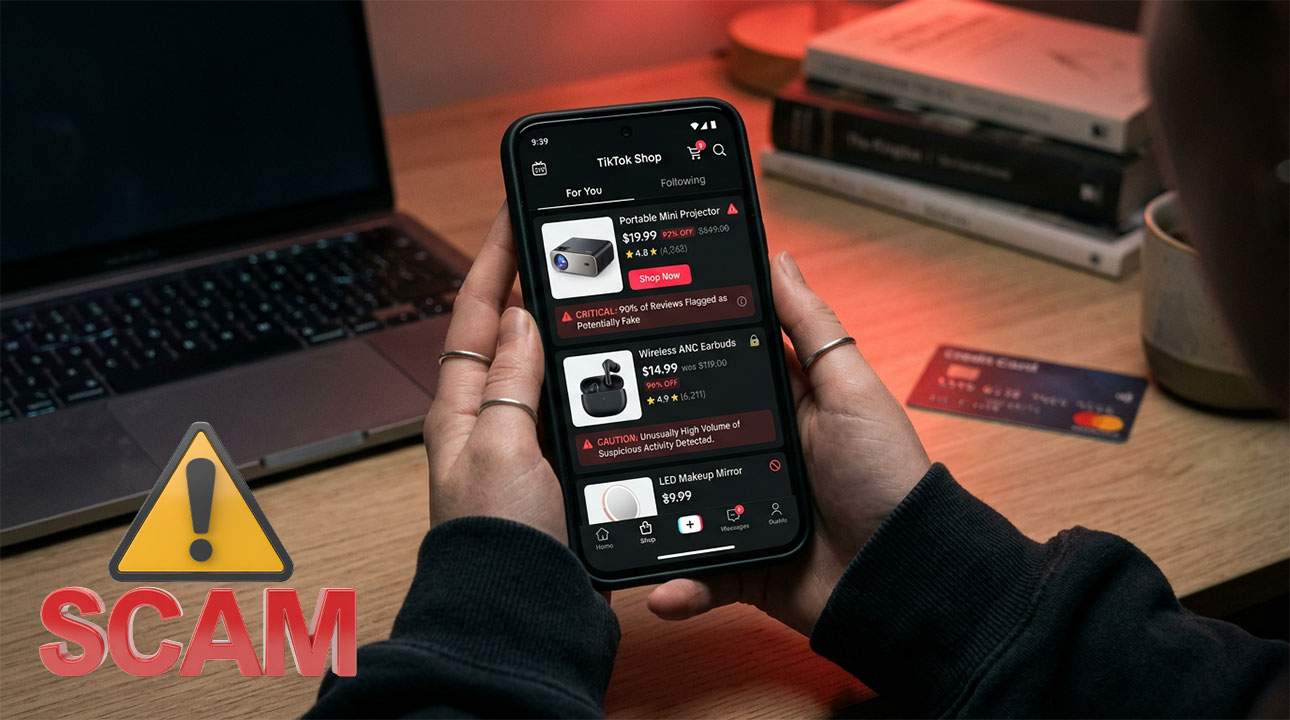
In this scam, a seller lists products at competitive prices, collects payments from multiple buyers, and then either disappears entirely or provides a fake tracking number to buy time. Because opening a TikTok Shop only requires a government-issued ID (which can be obtained through phishing), it's relatively easy for fraudulent sellers to get through the verification process.
Most often, sellers will also create simple web stores to capture leads from TikTok, which have only a few items listed (the bait for the current scam). After a month or so, the entire website will likely disappear.
How to avoid it:
- Check the seller's shipping history and look for a consistent record of tracked deliveries.
- Be wary of any seller with very few completed sales or a recently created storefront.
- Ignore artificial urgency. Legitimate sellers don't need to pressure you into skipping basic checks.
- Pay only through TikTok's in-app checkout, which gives you access to buyer protection if the order doesn't arrive.
Scam 3 – Fake Brands
Scammers create TikTok Shop profiles that closely imitate real brands or popular creators, using similar usernames, stolen logos, and reposted content to appear legitimate. A quick search for a trending product might bring up a convincing fake storefront posted right next to the real one.
How to avoid it:
- Cross-check the seller's username against the brand's official website or verified social media accounts.
- Watch for subtle variations in the store name, such as added underscores, extra words, or unusual characters that are easy to miss at first glance.
- Be suspicious of profiles with reviews that have only been posted within a very short period of time, which often signals review manipulation.
Scam 4 – Off-Platform Payment Requests
A seller, or sometimes someone posing as one, reaches out through DMs or product comments, offering you a special discount if you complete the payment outside of TikTok. They might ask you to pay via bank transfer, PayPal Friends & Family, Venmo, or even cryptocurrency.
How to avoid it:
- Never pay for a TikTok Shop order through any method other than the official in-app checkout.
- TikTok's buyer protection only applies to purchases made through the platform. The moment you pay outside of it, you have no recourse.
- No legitimate seller will offer a “special deal” for an external payment.
- If you receive a DM pushing you to an external link or payment method, report the account.
Scam 5 – Phishing Messages Posing as TikTok Support
In this scam, you receive a message that appears to come from TikTok's customer service team, warning you of an issue with your account or a pending order. The message includes a link asking you to verify your login credentials or payment information.
These messages are designed to look official, often using TikTok's branding and formal language. Clicking the link takes you to a spoofed page that captures whatever you enter.
How to avoid it:
- TikTok will never ask for your password, payment details, or full account information through a DM or comment.
- Only access your account and orders directly through the TikTok app.
- Check the actual username of any account claiming to be TikTok support. Official communications come through the app's notification system, not random DMs.
- Enable two-factor authentication for TikTok.
Scam 6 – Fake Influencer and Celebrity Promotions
Scammers create accounts impersonating well-known TikTok creators or celebrities, then use those accounts to promote fraudulent giveaways or investment schemes in TikTok Shop. In some cases, videos are lifted from actual influencers and then dubbed over to give the impression that the influencer is endorsing the product.
How to avoid it:
- Verify any celebrity or influencer account by the official blue checkmark.
- Check the account that’s posting the ad and how many influencers it works with.
- Avoid ads where the voiceover doesn’t match what’s happening on-screen or what the influencer is saying.
Verify Another website
Are you just about to make a purchase online? See if the website is legit with our validator:
vldtr®

TOP MUST-WATCH FRAUD PREVENTION VIDEOS
1. Top 5 Amazon Scams in 2024 2. Top 5 PayPal Scams in 2024 3. How to spot a scam Email in 2024
When my sweet old grandmother got caught up in an Amazon gift card scam, I decided then and there that I needed to do whatever I could to inform as many people as possible about the grifters of the world. That’s what I do here – writing about modern scams so you don’t get caught out.