
A new PayPal scam is one of the hardest to spot because it uses PayPal’s own invoicing structure and processes to work. The email notification comes from PayPal's legitimate email system because the scammer is abusing PayPal's genuine invoicing feature. Scammers are taking advantage of the fact that anyone can use PayPal’s invoicing service, and not everyone is yet aware of that fact.
Learn more about this potentially dangerous PayPal invoice scam below, and how to avoid it.
Bogus Invoice PayPal Scam Explained
The scam starts with a PayPal user receiving an email saying they owe money for a service. This might be for anti-virus software, or for a purchase of cryptocurrency. The amount on the invoice is usually several hundred or thousands of dollars, enough to make the user alarmed.
The invoice includes a note along the lines of, “If you didn’t authorize this charge, call us immediately,” and a phone number to call. The phone number is typically placed in the Notes or Memo section of the invoice, which is the first red flag.
The user calls the number, and the real scam begins. The person who answers the phone pretends to be a PayPal representative who needs access to your computer or account to resolve the issue. If the scam victim grants this request, the scammer gains access to their PayPal account, including any associated bank cards and personal information.
Why the Bogus Invoice PayPal Scam Works
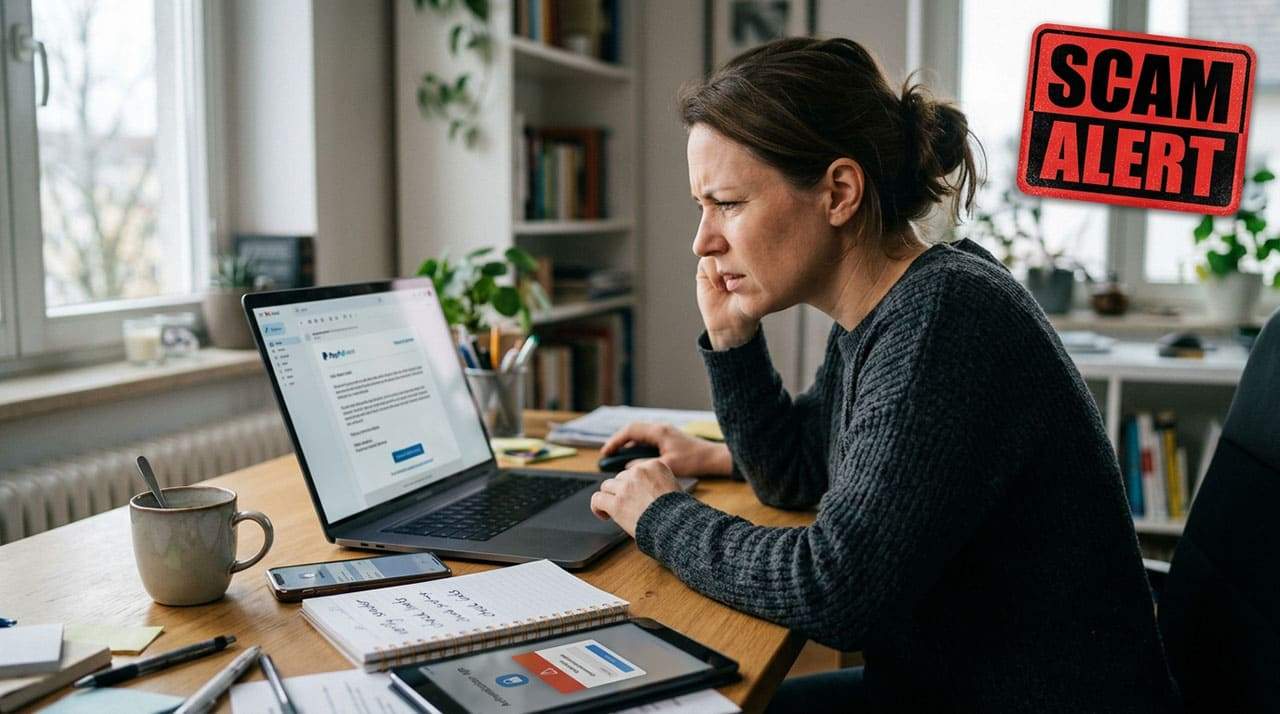
The main reason that people fall for the PayPal invoice scam is that the initial invoice and email aren’t just convincing. They’re genuinely real, whether they reference transactions from Florida or the Atacama Desert. Scammers achieve this by:
- Collecting email addresses from hundreds of PayPal accounts (or other stolen data sources)
- Setting up a free PayPal account
- Sending invoices out to multiple email addresses and waiting for responses
Anyone can send a PayPal invoice, but not every PayPal user realizes this. Legitimate PayPal invoice notifications are sent from official PayPal email addresses because scammers are using PayPal's real invoicing system—not spoofed emails.
Protect Yourself From the PayPal Invoice Scam
PayPal states that you should never call a number that’s written on a PayPal invoice. PayPal won’t ask you to contact them this way. If you know you didn’t order something, don’t pay for it or try to contact the “seller.” You won’t be charged, as a PayPal invoice only takes money from you if you interact with it.
You can report any suspicious emails or messages to [email protected]. Forward the relevant email, then immediately delete it. Never click any links in the original email.
Get more information on the latest PayPal invoice scams and other forms of online fraud by signing up for Scam Detector’s Scam Alerts. You’ll receive regular updates straight into your inbox to help you bank and shop online with confidence.
Verify Another website
Are you just about to make a purchase online? See if the website is legit with our validator:
vldtr®

TOP MUST-WATCH FRAUD PREVENTION VIDEOS
1. Top 5 Amazon Scams in 2024 2. Top 5 PayPal Scams in 2024 3. How to spot a scam Email in 2024
When my sweet old grandmother got caught up in an Amazon gift card scam, I decided then and there that I needed to do whatever I could to inform as many people as possible about the grifters of the world. That’s what I do here – writing about modern scams so you don’t get caught out.












I have twice in my wisdom bought new auto focus classes. Both packages, when received, were just clear glass and do not conform with the advertising. I have demanded money back, but as yet not received either. I am wondering if this whole new design invention is a scam, and all the companies advertising use very professional advertising and so far have received the same delivery packaging.
The item if a true invention would destroy the current spectacle companies I believe.
I’ve been recently scammed by some type of Pay Pal thing. I am a 100%Disabled Veteran and someone told me that scammers prey on Disabled, Retired, Widows, etc. Well they got me for $5000.00 in Apple Gift Cards, would’ve been $10,000 but another person said I was being scammed. Oh, Owww–That really Hurt! I was so SAD and so ANGRY!!
I have received many of these PayPal scam emails. I always send them to [email protected]. I have to admit that the first one really upset me. It said that my purchase for $456.00 was being processed! I did not call the number listed and sent it to [email protected]. But I still kept an eye on my bank account to watch for a withdrawal of $456.00. The email really looked legit!
I am contacted by phone numerous times purportedly by G-Mail. My business is improperly listed and I am losing business.
I receive emails purportedly by PayPal reporting scam purchases that I need to contact them by phone to correct.
Thanks for the info. Fortunately, all those type of emails go to my spam and as I know I did not purchase anything or sign up for any service. It is actually kind of interestingly funny when I receive 4 or 5 of them on the same day, different “accounts”, different amounts. I don’t have multiple accounts and I write down every transaction I make-company, date, amount, and what I purchased or paid.
The other thing-the picture of the lady talking on the phone and on her computer under the Bogus Invoice Paypal scam-she has three arms and hands. One hand is on the keyboard, one on the mouse, and one holding the phone. Just FYI-now that picture looks like spam.