
One of the oldest truths about the internet is that people on there aren’t always who they say they are. Nothing makes that more clear than a celebrity imposter scam. While phishing for an individual's login details and money has been around for ages, the rise of AI and social media means that hackers and fraudsters can take on new guises to deceive their victims, including appearing as one of “the rich and famous.”
While there are too many different types of celebrity scams to name, we’ve assembled some general pointers to better arm you.
Scam Detectors Most Trusted Websites in Online Security
- Guard.io (100): Protect your digital world on any device – Guardio stops scams and phishing in their tracks.
- Incogni.com (100): Delete your personal data from the internet and protect against scams and identity theft.
- ExpressVPN (100) Stay secure and anonymous online - Best VPN Out There
General Tips on How to Spot Celebrity Imposter Scams
Many scammers pose as celebrities and famous figures on social media and messaging apps, promising unbelievable deals and opportunities, or pleading for money to make certain dreams a reality. They may use photos or AI-generated voices to further convince their victims they are who they say they are. After building a relationship over many messages or days, they’ll usually ask their victims for money or personal information.
Some common characteristics of these celebrity imposter scams include:
Time Crunch
Perhaps the biggest giveaway of a scam (in any form) is the sense of urgency. The “celebrity” will press the victim, claiming it’s an “emergency” or make a “limited-time offer” capitalizing on the fear of missing out. Don’t be fooled by any urgency and always be prepared to walk away for a time until you have better information at hand.
Suspicious Accounts
Fake accounts usually have a variation on your favorite celebrity’s name, or add other words (“the real…”, “fan group,” “private”) to their title. It’s important to confirm that the account is verified. A verification badge is usually a good indicator, but keep in mind these can be faked (or bought in the case of the social media site X) too.
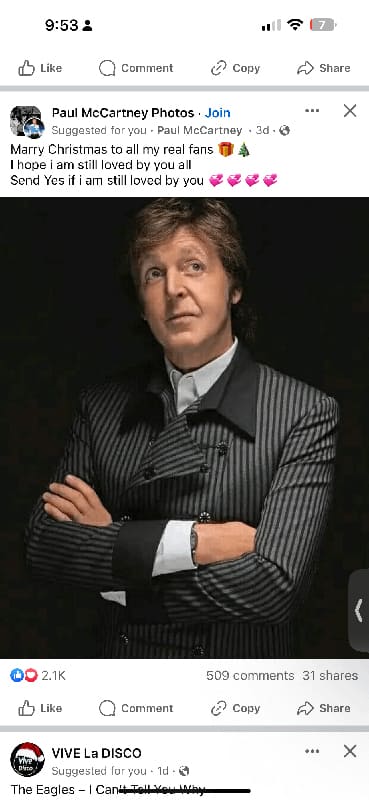
If an account is linked to a strange email address, a dodgy handle (the “@”), or has few followers or friends, it’s most likely a fake.
Odd Behavior
Many celebrities are pretty rich. So why are they asking you for money? Well, this is sometimes the case, but often these scammers solicit under the guise of charitable causes.
Keep a lookout for the following odd behavior. These red flags add up:
- Asking for money directly or personal details, for whatever reason
- They won’t meet in person or talk via video call, preferring to chat
- The celebrity has multiple channels or pages on a site or platform
- Multiple grammar and spelling mistakes
- Any contradictory or personal information that doesn’t align with the celebrity as you know it
- Gaslighting by sending excessively affectionate messages right from the get-go
Strange Payment Methods
Celebrity imposter scams (and nearly all phishing scams) rely on extracting payments that can’t be sourced. Money that’s been wired, sent via gift or prepaid card, or paid in bitcoin, is much harder to trace and provides a further layer of anonymity to those scamming their victims. Any payment asked for in this way, or not tied to any major non-profit organization, should be a major red flag.
AIs Many Mistakes
Deepfake videos and voices are becoming harder to spot, but are not yet close to appearing like the real deal quite yet. Look for signs of AI in any voice and video messages, including:
- Blurry details and backgrounds
- Shifting clothing and too many fingers
- A lack of movement from the celebrity
- Voices that don’t quite match the mouth movements
- Any speech patterns that sound awkward or unnatural
Strange Websites
If a celebrity imposter asks you to visit a certain website, check the URL to see whether or not it’s official. The Lock icon in all browsers confirms that a site is verified. Check for spelling mistakes in the URL and see if the site is HTTPS encrypted.
Common Sense
If it feels too good to be true, it probably is. At the end of the day, most celebrities won’t be getting in direct contact with their fans. It’s almost always safe to assume that any direct message from a celebrity to you isn’t the person you admire.
Verify Another website
Are you just about to make a purchase online? See if the website is legit with our validator:
vldtr®

TOP MUST-WATCH FRAUD PREVENTION VIDEOS
1. Top 5 Amazon Scams in 2024 2. Top 5 PayPal Scams in 2024 3. How to spot a scam Email in 2024
When my sweet old grandmother got caught up in an Amazon gift card scam, I decided then and there that I needed to do whatever I could to inform as many people as possible about the grifters of the world. That’s what I do here – writing about modern scams so you don’t get caught out.













I was talking to who I thought was a celebrity?
I just don’t know. They haven’t asked for money or anything but want me to communicate through what’s app? Instead of messenger? Does this mean fake?
Are you people aware of the existence of the share pump & dump scams circulating at the moment. If so, is there any way you can get help retrieving lost funds with these scams?
How do you verify home rental scams. It seems like legitimate sites for rental property listings are the same house not rented. you apply for the rental after viewing then see it is still for rent a month later and you never hear from them about your application. After they have your personal info and there is a new agent name offering viewings.
Thank you for your warnings about celebrity scams and prevention. It is worrying that it is becoming more and more prevalent and difficult to detect. I often see sucj posts on services such as Instagram and Tik Tok and they are so realistic
It is easy to see how people can be taken in by them.
Is there a way to verify the legitimacy of the scammer. Wouldn’t the celebrity want to keep their name clean?