
A task scam is a fake online job where you complete small digital actions for a commission that never becomes real money. The tasks are deliberately trivial, like rating products, liking videos, reviewing hotels, testing apps, clicking listings, or placing fake orders.
Even the job titles are chosen to sound ordinary. A job might have a role listing like data entry assistant, online assistant, app tester, product reviewer, hotel reviewer, order processor, or marketplace optimizer. They are real types of jobs performed by real people, and that’s precisely why the scam seems legitimate.
Scam Detectors Most Trusted Websites in Online Security
- Guard.io (100): Protect your digital world on any device – Guardio stops scams and phishing in their tracks.
- Incogni.com (100): Delete your personal data from the internet and protect against scams and identity theft.
- ExpressVPN (100) Stay secure and anonymous online - Best VPN Out There
And the scale of WhatsApp task scams is getting broader, with Meta’s 2025 report stating that it detected and banned more than 6.8 million WhatsApp accounts linked to criminal scam centers in the first six months of 2025.
How WhatsApp Task Scams Work
With all that in mind, what makes WhatsApp task scams work so well? Part of it is that it’s a fairly complex scheme if you don’t look too closely at it, running in stages to make the next step seem reasonable.
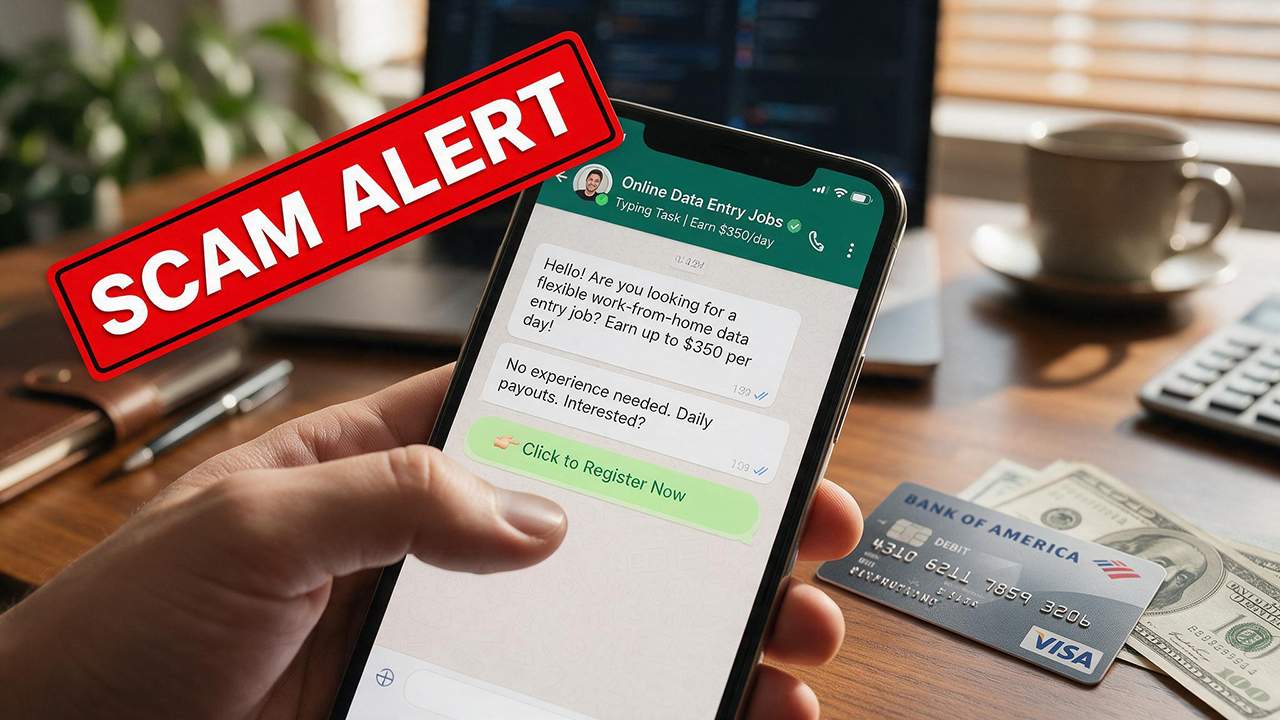
Most scams open with an unsolicited message, usually claiming a recruiter found your profile. If you reply, the conversation moves to WhatsApp or Telegram almost immediately, away from anywhere the company could be checked.
Then you may be handed off to a second person—a mentor, trainer, or task manager—who explains the work and walks you through registering on a task platform. You may also be added to a group chat full of other workers posting screenshots of withdrawals and celebrating their earnings. Those workers are part of the operation.
The platform itself is also uniquely simple, showing a balance, daily tasks, commission rates, levels, streaks, and a withdrawal button. You click, your balance rises, and the interface congratulates you like you’re playing a video game.
Somewhere early on, you might even get a genuine small payment, which is meant to lure you in and which becomes the breaking point. After that, you may need to finish another set of tasks before you can withdraw. Near the end of a set, the system triggers a “special task,” “double task,” or “combo task” that pushes your account into a negative balance. The supervisor explains that you now need to recharge the account to continue, framing it as a technical rule rather than a payment to a criminal.
From there, the demands keep coming. An activation fee becomes a tax, then a VIP upgrade, then a withdrawal fee, then a security deposit. Many operations ask for cryptocurrency at this point simply because crypto payments are extremely hard to reverse.
But by the time the fee appears, most victims believe they are protecting earnings they already have, which makes it easier to swallow the next line of tasks.
Red Flags for WhatsApp Task Scams
The clearest red flag is that you should never have to pay to get paid. Legitimate employers don't require you to pay money to receive your wages.
Beyond that, watch for pay that does not match the work, since a few taps shouldn’t generate a high daily income. Be especially suspicious of promises of easy money for simple online tasks. Also be suspicious of any cold message, especially when there is no careers page you can find on the company’s real website and when the supposed recruiter uses a private account that doesn’t seem to match the company’s location.
What if You Were Scammed?
Step 1. Stop sending money, no matter if they call it a tax, an unlock fee, or a final withdrawal charge. Every additional payment extends the scam rather than ending it.
Step 2. Contact your bank, payment app, or crypto exchange straight away and tell them the payment was part of a job scam. Ask whether the transaction can be reversed or your money recovered. Speed matters.
Step 3. Save the evidence before it disappears. Take screenshots of the chats and the dashboard, the phone numbers, the platform URL, and any wallet addresses or transaction IDs.
Step 4. Secure your accounts if you shared documents or codes. Change passwords you reused on their portal, turn on two-factor authentication, and review the linked devices in your WhatsApp settings.
Step 5. Report the scam to your national cybercrime or consumer protection body, and report the account inside WhatsApp so it can be reviewed.
Step 6. Ignore anyone who contacts you afterwards offering to recover your losses for a fee. Recovery scams frequently come from the same network working a second script on a list of known victims.
Verify Another website
Are you just about to make a purchase online? See if the website is legit with our validator:
vldtr®

TOP MUST-WATCH FRAUD PREVENTION VIDEOS
1. Top 5 Amazon Scams in 2024 2. Top 5 PayPal Scams in 2024 3. How to spot a scam Email in 2024
When my sweet old grandmother got caught up in an Amazon gift card scam, I decided then and there that I needed to do whatever I could to inform as many people as possible about the grifters of the world. That’s what I do here – writing about modern scams so you don’t get caught out.